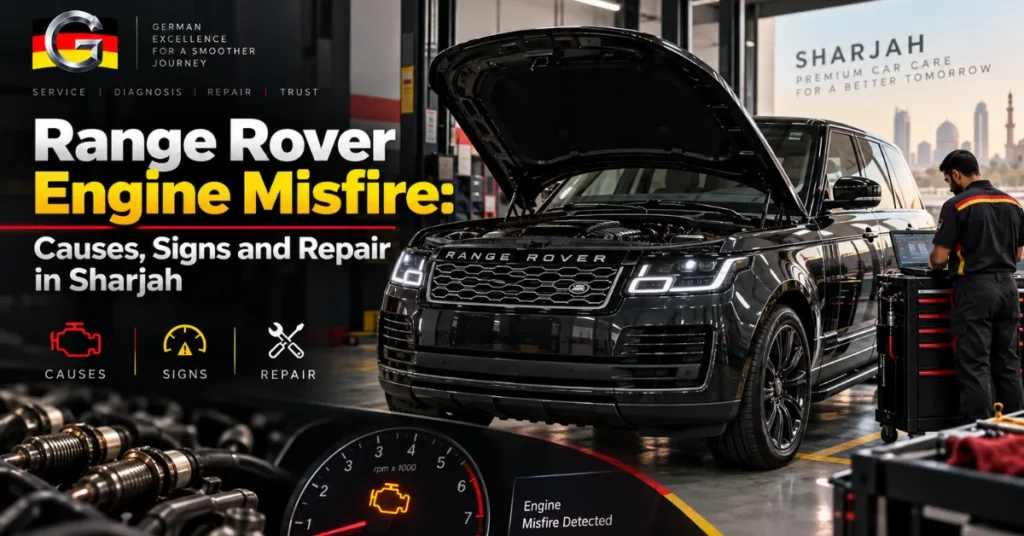
A Range Rover garage can properly diagnose an engine misfire when your vehicle starts shaking, losing power, idling roughly, or showing a check engine light.
An engine misfire happens when one or more cylinders do not burn the air and fuel mixture correctly. When this happens, your Range Rover may feel rough, weak, or unstable while driving.
For Range Rover owners in Sharjah and across the UAE, a misfire should not be ignored. Several different engine or ignition problems can cause the same symptoms, so proper diagnosis is important before replacing parts.
Common Signs of a Range Rover Engine Misfire
You may notice:
- Rough or unstable idle
- Engine shaking or vibration
- Jerking while driving
- Weak acceleration
- Loss of engine power
- Difficult starting
- Increased fuel consumption
- Check engine light
The problem may be constant or only appear during acceleration, when starting the vehicle, or after the engine becomes warm.
What Causes a Range Rover Engine Misfire?
There is no single cause of a misfire. Some of the most common problems include:
Worn Spark Plugs
Old, damaged, or fouled spark plugs may not create a strong and consistent spark. This can lead to engine shaking, rough idling, and poor acceleration.
Faulty Ignition Coils
Ignition coils provide the voltage needed by the spark plugs. A weak or damaged coil can cause one or more cylinders to misfire.
Fuel Injector Problems
A blocked or faulty fuel injector may not supply the correct amount of fuel to the cylinder, resulting in poor combustion and engine misfires.
Air Intake or Sensor Problems
Air leaks, faulty sensors, or intake system problems can affect the air and fuel mixture and reduce engine performance.
Mechanical Engine Problems
Low compression, valve problems, timing issues, or other internal engine faults can also cause repeated or more serious misfires.
Why You Should Not Ignore an Engine Misfire
Continuing to drive with an active misfire may make the problem worse.
It can lead to:
- Higher fuel consumption
- Reduced engine performance
- Additional stress on ignition components
- Catalytic converter problems
- Higher repair costs
- Possible vehicle breakdown
If your Range Rover is shaking badly, losing significant power, or showing a flashing check engine light, it is better to have the vehicle inspected promptly.
How Is a Range Rover Misfire Diagnosed?
A proper computer diagnosis usually starts with a scan to check engine fault codes and identify which cylinder or system may be affected.
A technician may then inspect or test:
- Spark plugs
- Ignition coils
- Fuel injectors
- Air intake system
- Engine sensors
- Wiring and electrical connections
- Fuel delivery system
- Cylinder compression when required
This helps identify the actual cause instead of replacing parts unnecessarily.
Fixing the Actual Cause of the Misfire
Once the fault is identified, the correct repair can be carried out.
Depending on the problem, this may include replacing spark plugs, changing a faulty ignition coil, repairing an injector, fixing an air leak, repairing wiring, replacing a sensor, or engine repair.
Repair costs can vary because a simple spark plug or ignition coil problem is very different from a fuel injector or internal engine fault.
This is why diagnosis should always come first.
What If the Misfire Keeps Coming Back?
If the misfire returns after parts have already been replaced, there may be another problem causing those components to fail.
For example, repeatedly changing spark plugs may not solve the issue if oil contamination, injector problems, an incorrect fuel mixture, or another engine fault is responsible.
A Range Rover garage can find the source of the misfire and repair the actual problem instead of repeatedly replacing the same parts.
What Should You Expect After Repair?
After the cause has been properly fixed, you should notice improvements such as:
- Smoother engine idle
- Reduced shaking and vibration
- Better acceleration
- Normal engine power
- Easier starting
- Less hesitation or jerking
- Improved overall driving performance
The vehicle should also be tested after the repair to confirm that the misfire has been resolved.
Conclusion
A Range Rover engine misfire can be caused by spark plugs, ignition coils, fuel injectors, sensors, air intake problems, fuel delivery issues, or internal engine faults.
For drivers in Sharjah and the UAE, getting the problem diagnosed early can help prevent unnecessary parts replacement and more expensive repairs.
The right approach is to identify the exact cause, repair the faulty component or system, and confirm that the engine is running smoothly again.